How to read cryptocurrency charts and indicators is your gateway to mastering the dynamic world of digital currencies. Understanding these charts not only empowers you to make informed trading decisions but also enhances your ability to predict market trends and movements. Whether you’re a novice or an experienced trader, grasping the fundamentals of chart analysis can significantly elevate your trading game.
From candlestick patterns that reveal market sentiment to volume indicators that validate price movements, this guide will walk you through essential tools for interpreting cryptocurrency charts. You’ll learn to identify crucial support and resistance levels while employing technical analysis strategies to capture potential trading opportunities.
Understanding the Basics of Cryptocurrency Charts
Cryptocurrency charts are essential tools for traders and investors, serving as visual representations of market movements, trends, and sentiments. Understanding these charts is crucial for making informed trading decisions. This segment will explore the fundamental components that constitute cryptocurrency charts, the various types of charts available for traders, and the importance of timeframes in analysis.
Fundamental Components of Cryptocurrency Charts
Cryptocurrency charts comprise several key components that provide insights into market dynamics. Each element plays a significant role in understanding price movements and making strategic decisions.
- Price Data: The primary information displayed on cryptocurrency charts is price data, which indicates how much a cryptocurrency is worth at various points in time.
- Volume: Volume represents the number of units traded over a specific timeframe, providing context to price movements and indicating market strength.
- Indicators: Traders often use various technical indicators like Moving Averages, RSI, or MACD to analyze trends and potential price movements.
- Chart Patterns: Recognizable formations, known as chart patterns, such as head and shoulders or flags, help traders predict future price action.
Types of Charts Used in Cryptocurrency Trading
Different types of charts provide varying perspectives on market data, catering to diverse trading strategies and preferences. Knowing the types of charts helps traders choose the best fit for their analytical approach.
- Line Charts: A simple chart that displays the closing prices over a set period, allowing for a quick visual overview of price trends.
- Bar Charts: Each bar represents a time period and displays the opening, closing, high, and low prices, providing more detail than line charts.
- Candlestick Charts: These charts show the same data as bar charts but in a more visually appealing format, using colored bodies to indicate price movements. A green or white body indicates a price increase, while a red or black body indicates a decrease.
- Point and Figure Charts: This type skips time and focuses solely on price movements, making it useful for identifying trends without the noise of time intervals.
Role of Timeframes in Analyzing Cryptocurrency Charts
Timeframes are critical in cryptocurrency analysis, as they influence the interpretation of price movements. Different timeframes can yield vastly different trading signals and insights.
- Short-Term Timeframes: Charts that display data in minutes or hours are ideal for day traders who thrive on volatility and quick price changes.
- Medium-Term Timeframes: Daily or weekly charts cater to swing traders, allowing them to capture medium-term price movements while managing risk effectively.
- Long-Term Timeframes: Monthly charts are suited for long-term investors focused on fundamental value rather than short-term fluctuations, helping them to identify overarching trends.
Understanding the nuances of timeframes can significantly enhance a trader’s ability to react to market events and make informed decisions.
Interpreting Price Movements Through Candlestick Patterns: How To Read Cryptocurrency Charts And Indicators
Candlestick patterns serve as essential tools for traders seeking to understand market dynamics and make informed decisions. These visual representations of price movements provide invaluable insights into market sentiment, allowing investors to anticipate potential reversals and continuations in price trends.The significance of candlestick patterns lies in their ability to communicate market psychology in a straightforward manner. Each candlestick provides information on the opening, closing, high, and low prices over a specific time frame, creating a visual narrative of market activity.
Recognizing patterns formed by these candlesticks can help traders gauge the strength of a trend and identify potential points of entry or exit.
Candlestick Formations and Their Implications for Investors, How to read cryptocurrency charts and indicators
Understanding different candlestick formations is crucial for interpreting market behavior and making strategic trading decisions. Traders often analyze these patterns to predict future price movements based on historical price action.Some of the most significant candlestick patterns include:
- Doji: A doji candlestick occurs when the opening and closing prices are virtually the same, indicating indecision in the market. It can signal a potential reversal, especially when found at the peak of an uptrend or the bottom of a downtrend.
- Hammer: The hammer pattern forms after a downtrend and has a small body with a long lower shadow. This indicates that buyers attempted to push the price up, suggesting a potential reversal.
- Engulfing Pattern: This pattern consists of two candles; a smaller candle followed by a larger candle that engulfs the first. A bullish engulfing pattern signifies a potential reversal to the upside, while a bearish engulfing pattern indicates a potential reversal to the downside.
- Morning Star: This three-candle pattern typically indicates a bullish reversal. It consists of a long bearish candle, followed by a small-bodied candle, and then a long bullish candle that closes well into the first candle’s body.
- Evening Star: The evening star is the opposite of the morning star and indicates a bearish reversal. It starts with a long bullish candle, followed by a small-bodied candle, and concludes with a long bearish candle.
These patterns hold distinctive implications for traders. Recognizing the context in which they appear is crucial; for instance, a hammer pattern in a strong downtrend might suggest a reversal, while the same hammer in a sideways market could signal continued indecision. Reading and utilizing candlestick charts effectively involves looking for these patterns while considering additional indicators such as volume and trend lines.
For instance, a bullish engulfing pattern accompanied by increasing volume often solidifies the likelihood of a price reversal, enhancing the trading decision’s reliability. The visual aspect of candlestick charts makes them an effective tool for traders at any level. By familiarizing oneself with these formations and their implications, investors can develop a more nuanced understanding of market movements and improve their trading strategies.
Understanding candlestick patterns is crucial for interpreting market behavior and making strategic trading decisions.
Analyzing Volume Indicators for Enhanced Trading Decisions
Understanding trading volume is crucial for any trader looking to make informed decisions in the cryptocurrency market. Volume indicates the total number of assets traded over a specific period and serves as a confirmation tool for price movements. By analyzing volume alongside price charts, traders can gain insights that significantly enhance their trading strategies.Volume bars, shown at the bottom of price charts, represent the number of assets traded during a given timeframe.
A rising price accompanied by increasing volume suggests strong buying interest, indicating that the price movement is likely sustainable. Conversely, if prices rise but volume decreases, it might signal a potential reversal or weakening trend. This interplay between volume and price is fundamental in confirming the strength of a trend.
Common Volume Indicators and Their Applications
Several volume indicators can provide valuable insights when analyzing cryptocurrency charts. Each indicator serves a unique purpose in helping traders make informed decisions. Here are some of the most commonly used volume indicators:
1. On-Balance Volume (OBV)
This indicator combines price and volume to show the cumulative buying and selling pressure. An increasing OBV suggests that buyers are willing to push the price higher, while a declining OBV indicates selling pressure.
Understand how the union of How to create a video marketing strategy from scratch can improve efficiency and productivity.
2. Volume Moving Average
This indicator smooths volume data over a specified period, helping traders identify trends more clearly. When the current volume exceeds the moving average, it can indicate potential breakouts or reversals.
3. Accumulation/Distribution Line (A/D Line)
This indicator combines price and volume to show whether an asset is being accumulated (bought) or distributed (sold). A rising A/D line suggests accumulation, while a falling A/D line indicates distribution.
4. Chaikin Money Flow (CMF)
This indicator evaluates the buying and selling pressure over a specific period. A positive CMF indicates strong buying pressure, while a negative CMF suggests selling pressure.
5. Volume Rate of Change (VROC)
Discover how how to export videos in different formats using software has transformed methods in this topic.
This indicator measures the rate of change in volume over a set period. A rising VROC indicates increasing interest and activity, while a declining VROC may suggest waning interest.Incorporating these volume indicators into your trading strategy can significantly enhance your decision-making process. By understanding how they interact with price movements, traders can better anticipate potential market shifts and act accordingly.
“Volume is the fuel that drives price action; without it, trends cannot sustain.”
Utilizing Moving Averages to Identify Trends
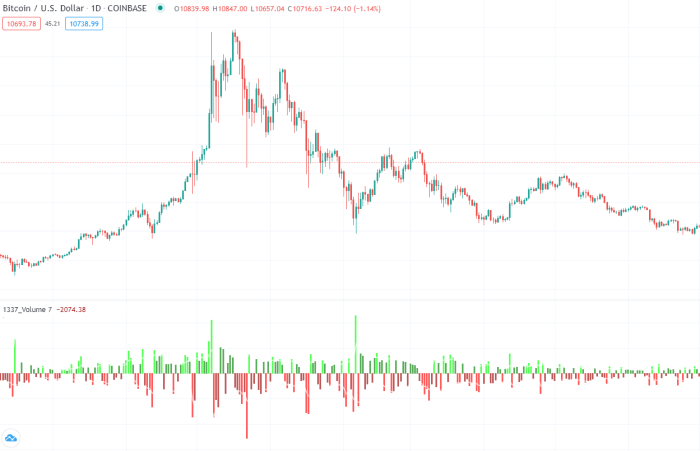
Moving averages are vital tools in the analysis of cryptocurrency charts, providing traders with essential insights into market trends. By smoothing out price data over specific periods, moving averages help to identify potential support and resistance levels, making them invaluable for forecasting future price actions. Understanding how to effectively calculate and utilize these averages can significantly enhance your trading strategies.Moving averages are calculated by taking the average of a designated number of past price points over a specified period.
This method reduces the noise caused by short-term fluctuations and highlights the underlying trend. The two most common types of moving averages are the Simple Moving Average (SMA) and the Exponential Moving Average (EMA).
Types of Moving Averages and Their Uses
The choice of moving average can influence trading decisions, as each type serves different purposes. Here’s a breakdown of the various types and their applications:
- Simple Moving Average (SMA): This is the most straightforward moving average, calculated by summing the closing prices over a set period and dividing by the number of periods. It is useful for identifying overall trends and is often used in longer-term trading strategies.
- Exponential Moving Average (EMA): The EMA gives more weight to recent prices, making it more responsive to new information. This feature makes it particularly valuable for short-term trading where quick reactions to price movements are required.
- Weighted Moving Average (WMA): Similar to the EMA, the WMA assigns different weights to each price point. This allows traders to emphasize certain periods more than others, providing more flexibility in trend analysis.
Understanding the characteristics of these moving averages is crucial, as they can be integrated into various trading strategies. To gain the most effective insights from moving averages, traders often implement crossover strategies, where different moving averages intersect, signaling potential buy or sell opportunities.
Applying Moving Averages for Forecasting
Using moving averages for forecasting involves recognizing patterns and trends that can indicate future price movements. Here are effective methods to apply moving averages in trading:
- Trend Identification: A rising moving average suggests an upward trend, while a declining moving average indicates a downtrend. Traders look for these trends to determine the overall market direction.
- Support and Resistance Levels: Moving averages often act as psychological support or resistance levels. For example, if the price approaches a moving average during a downtrend, it may bounce back, signaling a potential buying opportunity.
- Crossover Signals: A common trading strategy involves observing when the short-term moving average crosses above a long-term moving average, known as a “golden cross”, which can signal a buying opportunity. Conversely, a “death cross” occurs when the short-term average crosses below the long-term average, indicating a potential sell signal.
Incorporating moving averages into your trading strategy can significantly enhance your decision-making process. By understanding their calculation, different types, and methods for forecasting, traders can gain a competitive edge in the cryptocurrency market, positioning themselves for potential profit opportunities.
Exploring Momentum Indicators for Better Insights
Momentum indicators are critical tools for traders looking to gauge the strength of price movements in the cryptocurrency market. These indicators help assess whether a trend is likely to continue or reverse, empowering traders to make informed decisions. Understanding and utilizing momentum indicators can significantly enhance your trading strategy, allowing you to capitalize on market movements more effectively.Momentum indicators measure the rate of change in the price of an asset.
They help traders identify the strength of a trend and signal potential reversals or continuations. By observing these indicators, traders can determine whether to enter or exit positions based on the market’s momentum. Several popular momentum indicators are widely used in cryptocurrency trading, each serving a unique purpose.
Popular Momentum Indicators and Their Functionalities
Familiarizing yourself with the most common momentum indicators can provide you with valuable insights into market dynamics. Below are some of the key indicators and their functionalities:
- Relative Strength Index (RSI): This indicator ranges from 0 to 100, measuring the speed and change of price movements. An RSI above 70 typically indicates overbought conditions, while an RSI below 30 indicates oversold conditions.
- Moving Average Convergence Divergence (MACD): The MACD consists of two moving averages and a histogram that indicates the momentum of price changes. A crossover of the MACD line over the signal line suggests bullish momentum, while a crossover below indicates bearish momentum.
- Stochastic Oscillator: This indicator compares a particular closing price of an asset to its price range over a specific period. Readings above 80 suggest overbought conditions, while readings below 20 indicate oversold conditions.
- Average True Range (ATR): While not a momentum indicator per se, the ATR measures market volatility, helping traders gauge the strength of a price movement. High ATR values indicate strong momentum, while low values signify weaker price movements.
Interpreting these indicators effectively can lead to successful trading decisions. The RSI, for instance, can help traders identify potential reversal points. If the RSI is approaching 70 and prices are rising rapidly, traders might consider taking profits before a possible price correction occurs. Conversely, an RSI below 30 on a downtrend may signal a potential buying opportunity as the market could be due for a rebound.In the case of the MACD, bullish crossovers can serve as a buy signal, while bearish crossovers might indicate a time to sell.
A trader might observe a bullish crossover after a sustained downtrend, indicating a possible trend reversal, thus presenting an ideal entry point.
Understanding and utilizing momentum indicators enhances your trading strategy, allowing you to capitalize on market movements effectively.
Examples in real trading scenarios highlight the effectiveness of momentum indicators. For instance, during the recent bull market in 2021, many traders observed the RSI reaching extreme levels above 70, signaling overbought conditions in several cryptocurrencies. By heeding this indicator, they were able to secure profits before a market correction occurred.Similarly, traders who monitored the MACD found significant success during the bullish run of Bitcoin after a crossover.
This timely signal allowed many to enter the market early, reaping substantial rewards as prices surged.By leveraging momentum indicators, traders can gain deeper insights into market strength and make more informed decisions, ultimately improving their trading outcomes.
Understanding Support and Resistance Levels
Support and resistance levels are fundamental concepts in cryptocurrency trading, acting as critical points where price movements tend to pause or reverse. These levels reflect the supply and demand dynamics in the market and provide traders with insights into potential price action. Mastering the identification and interpretation of these levels is essential for making informed trading decisions.Support refers to a price level where a downtrend can be expected to pause due to a concentration of demand.
When the price approaches this level, buyers tend to enter the market, believing that the asset is undervalued. Conversely, resistance is where the price faces upward pressure and typically struggles to breach, as sellers come in at this level, often viewing it as overvalued. Understanding these levels enhances a trader’s ability to forecast price movements.
Identifying Support and Resistance Levels
Identifying key support and resistance levels is an essential skill for any trader. Here are effective techniques used to spot these critical points on cryptocurrency charts:
- Historical Price Levels: Review past price movements to find areas where the price has frequently reversed. Historical highs and lows act as strong indicators of future support or resistance.
- Trend Lines: Draw trend lines by connecting the highs in a downtrend to find resistance and the lows in an uptrend for support. This visual representation helps clarify market sentiment.
- Moving Averages: Utilize moving averages, such as the 50-day or 200-day, as dynamic support and resistance levels. Prices often interact with these averages, leading to potential bounce or rejection points.
- Fibonacci Retracement Levels: Apply Fibonacci retracement levels to identify potential support and resistance zones based on the numerical relationships found in nature. Traders often pay close attention to levels such as 38.2%, 50%, and 61.8%.
- Volume Profile: Analyze trading volume at different price levels. High volume around a specific price indicates strong support or resistance, as traders are more likely to execute trades at these levels.
Traders often leverage support and resistance levels to devise their strategies. For example, many traders use these levels to set stop-loss orders, allowing them to protect their investments. A common practice is to place stop-loss orders slightly below support when buying and above resistance when short-selling. This strategy minimizes losses while allowing for potential gains when the price moves in their favor.Moreover, traders frequently look for breakouts or breakdowns at these levels.
A breakout above resistance could signal a bullish trend, while a breakdown below support may indicate a bearish trend. These reactions often lead to significant price movements, making them prime opportunities for profit.
“Support and resistance levels are not just static points; they evolve as new market information comes into play, reflecting the ongoing battle between buyers and sellers.”
Analyzing Market Sentiment Through Indicators
Understanding market sentiment is crucial for any trader looking to navigate the volatile world of cryptocurrency. Market sentiment indicators provide valuable insights into the emotions and attitudes of market participants, influencing trading strategies significantly. By gauging the prevailing sentiment, traders can make informed decisions, aligning their strategies with market psychology rather than solely relying on technical analysis.Market sentiment indicators serve as the heartbeat of the market, reflecting the emotions that drive price movements.
Browse the implementation of What types of videos work best for businesses in real-world situations to understand its applications.
These indicators can range from quantitative metrics to qualitative measures, allowing traders to assess whether the market is in a state of fear or greed. Recognizing these sentiment shifts is essential because they often precede significant price changes. For instance, when sentiment indicators show excessive greed, it may signal an impending market correction, while extreme fear could indicate a buying opportunity.
Key Market Sentiment Indicators
There are several prominent market sentiment indicators that traders utilize to interpret market conditions effectively. The following examples highlight their significance and how traders can incorporate them into their strategies:
- Fear and Greed Index: This index measures market sentiment on a scale from 0 to 100, with lower values indicating fear and higher values indicating greed. For example, a reading above 75 typically suggests a market that is overbought, potentially signaling a correction. Conversely, a reading below 25 indicates oversold conditions, often presenting buying opportunities.
- Social Media Sentiment Analysis: Tracking mentions and sentiment on platforms like Twitter can provide insights into public opinion about specific cryptocurrencies. Positive mentions often correlate with price increases, while negative sentiment can lead to declines. Tools like sentiment analysis software analyze the tone of social media posts and provide actionable insights.
- Volume Analysis: An increase in trading volume accompanying price movements can indicate strong sentiment. For instance, if a cryptocurrency’s price rises sharply on high volume, it suggests strong bullish sentiment. In contrast, a price rise on low volume may indicate weak support and could be a warning sign.
Market sentiment has a direct relationship with price movements. When traders collectively feel optimistic about a cryptocurrency’s future, buying pressure tends to increase, resulting in price appreciation. Conversely, if fear dominates the market, traders may sell their assets, leading to price declines. This interplay between sentiment and price underscores the importance of incorporating sentiment analysis into trading strategies.
“The essence of trading lies in understanding not just the numbers, but the emotions that drive them.”
By leveraging these sentiment indicators, traders can better anticipate market trends, enhancing their strategic positioning in the dynamic world of cryptocurrencies.
Implementing Technical Analysis Strategies
Understanding and implementing effective technical analysis strategies is fundamental for traders looking to navigate the cryptocurrency markets successfully. These strategies provide traders with critical insights into price movements, market trends, and potential entry and exit points, enabling informed decision-making.Various technical analysis strategies can be adopted by traders to enhance their trading effectiveness. Each of these approaches can be tailored to suit individual trading styles and risk tolerance levels, leading to better overall performance.
Common Technical Analysis Strategies
Several widely used technical analysis strategies can help traders interpret market data more effectively. Here are some key strategies:
- Trend Following: This strategy involves identifying and following the prevailing market direction. Traders look for patterns that indicate whether the market is in an uptrend or downtrend and make trades accordingly. For instance, during an uptrend, a trader may look to buy on pullbacks.
- Support and Resistance Levels: Identifying critical support and resistance levels can assist traders in determining where to place trades. These levels highlight where price action tends to reverse, providing crucial points for entry and exit.
- Moving Averages: Utilizing moving averages helps smooth out price data and identifies the direction of the trend. Traders often look at the crossover of short-term and long-term moving averages as potential buy or sell signals.
- Chart Patterns: Recognizing chart patterns such as head and shoulders, triangles, or flags can provide insights into potential future price movements. These patterns often indicate continuation or reversal of trends.
- Momentum Indicators: Tools like the Relative Strength Index (RSI) or Moving Average Convergence Divergence (MACD) gauge the strength of price movements, helping traders to identify overbought or oversold conditions.
The importance of backtesting strategies cannot be overstated. Backtesting involves applying a trading strategy to historical data to evaluate its performance. This process enables traders to identify the effectiveness of their strategies before utilizing real capital.
Importance of Backtesting Strategies
Backtesting strategies help traders assess potential profitability and identify weaknesses in their approach. By analyzing past market conditions, traders can determine whether their strategies would have been successful or not.Backtesting should include the following aspects:
- Historical Data Analysis: Traders should leverage comprehensive historical price data to simulate trades as if they were executed in real-time.
- Risk Management Testing: Evaluating how the strategy performs under various risk scenarios, including drawdowns, helps to prepare for adverse market conditions.
- Performance Metrics: Reviewing metrics such as win rate, average profit/loss, and maximum drawdown will provide insights into overall strategy effectiveness.
Combining multiple indicators for a more comprehensive analysis can lead to better-informed trading decisions. Utilizing different indicators can provide a more nuanced view of market conditions.
Combining Multiple Indicators
A multi-indicator approach allows traders to confirm signals and reduce the chances of false entries. Here are key insights for combining indicators effectively:
- Divergence Analysis: By comparing price movements with momentum indicators, traders can identify potential trend reversals or continuations.
- Signal Confirmation: Using multiple indicators, such as a moving average alongside the RSI, can help confirm entry points, solidifying the trader’s confidence in a decision.
- Timeframe Analysis: Implementing indicators across different timeframes allows for a broader market perspective, aiding traders in recognizing macro trends while executing micro trades.
Incorporating these strategies and principles into a trader’s routine can significantly enhance their ability to read cryptocurrency charts and indicators, ultimately leading to better trading outcomes.
Ultimate Conclusion
In conclusion, mastering how to read cryptocurrency charts and indicators is essential for anyone looking to navigate the complexities of crypto trading. By combining various analytical tools and techniques, you can refine your trading strategies and make smarter, more confident decisions in the fast-paced crypto market. Embrace the insights shared in this guide, and watch your trading skills flourish!